

Understanding EMDR therapy
Discover how EMDR therapy can help you process and heal from troubling memories and trauma, leading to lasting relief and well-being. I am here to guide you on your journey to recovery.
What is EMDR therapy?
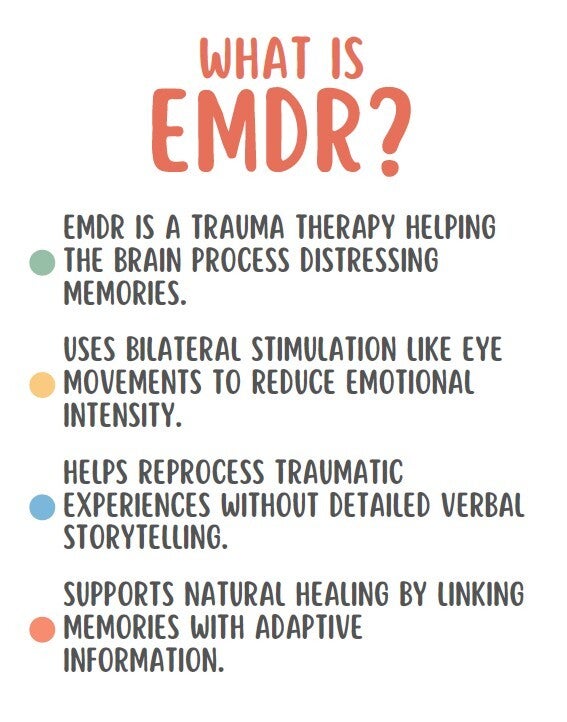
Eye Movement Desensitization and Reprocessing therapy, commonly referred to as EMDR, is an innovative approach to mental health treatment. This therapy specifically addresses mental health issues stemming from traumatic memories. While EMDR is most recognized for its effectiveness in treating post-traumatic stress disorder (PTSD), its application is broadening to encompass a variety of other mental health conditions.
EMDR therapy is an innovative mental health treatment designed to help individuals process and heal from traumatic memories. This technique involves guided eye movements that facilitate the processing of distressing experiences. The primary objective of EMDR is to promote healing from trauma and other challenging life events. Although EMDR is a relatively recent development in the field of therapy, with its first clinical trial conducted in 1989, numerous subsequent studies have demonstrated its effectiveness, often enabling faster recovery compared to traditional therapeutic approaches.

Who needs to have EMDR therapy?
EMDR can help people with a wide range of mental health conditions. Adolescents, teenagers and adults of all ages can benefit from this treatment. Some healthcare providers also specialize in EMDR for children.
Why is this treatment used?
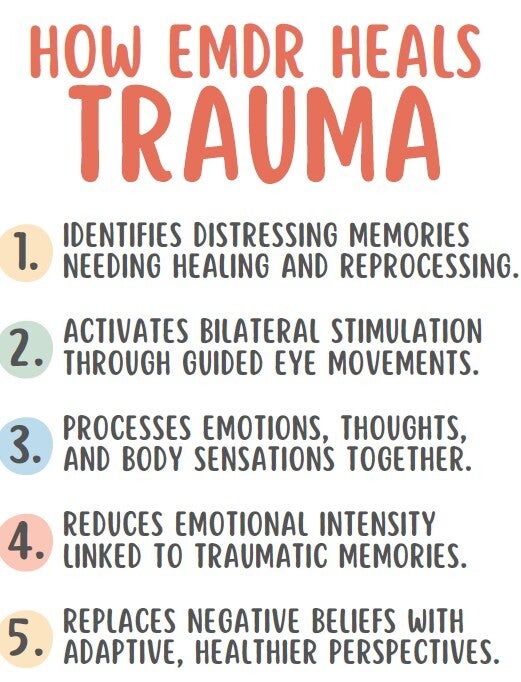
EMDR therapy does not require in-depth discussions about distressing issues. Instead, it focuses on transforming the emotions, thoughts, and behaviors stemming from traumatic experiences. This approach enables your brain to re-engage in its natural healing process. While many people use the terms "mind" and "brain" interchangeably, they refer to distinct concepts. Your brain is a physical organ, whereas your mind encompasses the collection of thoughts, memories, beliefs, and experiences that define who you are.
The functioning of your mind is intricately linked to the structure of your brain, which consists of networks of communicating brain cells across various regions. This is particularly true for areas associated with memory and sensory perception. Such connectivity enhances the efficiency and speed with which these regions collaborate, explaining why your senses—sights, sounds, smells, tastes, and tactile sensations—can evoke vivid memories.
Adaptive Information Processing
EMDR is based on the Adaptive Information Processing (AIP) model, a framework that explains how our brains store memories. Developed by Francine Shapiro, PhD, who also created EMDR, this theory highlights the distinct ways in which our brains handle normal versus traumatic memories.
In typical situations, our brains store memories seamlessly, linking them to other related experiences. However, during distressing or traumatic events, this process can falter. The brain may go "offline," leading to a disconnect between what we feel, hear, or see and how these experiences are encoded in memory.
Often, trauma memories are stored in a manner that hinders healthy healing. They become akin to a wound that hasn’t had the opportunity to heal properly. As a result, the brain fails to recognize that the threat has passed.
New experiences can trigger earlier traumatic memories, perpetuating negative feelings and reinforcing distress. This disrupts the connections between our senses and memories, creating a psychological injury. Just as our bodies react sensitively to physical pain, our minds become more attuned to stimuli associated with past traumas, such as sights, sounds, smells, or feelings.
This phenomenon occurs not only with memories we consciously recall but also with those we suppress. Similar to how we learn to avoid touching a hot stove to prevent burns, our minds attempt to block out painful memories. Unfortunately, this suppression is not foolproof, meaning the underlying "injury" can still manifest as negative symptoms, emotions, and behaviors.


What are the Advantages and Disadvantages of EMDR?
EMDR offers several notable advantages.
- Proven Effectiveness. Numerous studies have demonstrated that EMDR is an effective treatment.
- Faster Results. Many individuals undergoing EMDR begin to see improvements more quickly than with other therapeutic approaches.
- Minimal Homework. Unlike other therapies that often require journaling or additional tasks between sessions, EMDR typically only asks you to jot down any thoughts or concerns you wish to discuss in your next appointment.
- Lower Stress Levels. EMDR emphasizes processing and moving forward from trauma, as opposed to other methods that may require you to recount or relive distressing events.
Disadvantages
However, EMDR does have some limitations compared to other therapeutic options.
- Limited Applicability. EMDR is primarily effective for conditions linked to traumatic experiences. If your mental health issues stem from genetic factors, injuries, or other physical influences on the brain, EMDR may not be beneficial.
- Theoretical Understanding. While EMDR was discovered by chance, experts have yet to fully elucidate the mechanisms behind its effectiveness, despite the substantial evidence supporting its use.
- Relative Newness. EMDR was developed in 1989, whereas many other therapeutic modalities have been established for much longer. Further research is needed to determine whether EMDR is a sustainable long-term solution or if individuals may require additional therapy in the future.
What are the Risks or Complications of This Procedure?
EMDR is associated with very few risks. The most common side effects include experiencing negative thoughts or emotions between sessions. Your healthcare provider can guide you on what to expect and how to manage these feelings effectively.
What Does EMDR Therapy Involve?
EMDR therapy unfolds over eight distinct phases, typically spanning multiple sessions. In some cases, a single session may incorporate elements from several phases. For instance, phases 1 and 2 are generally completed in the initial sessions, while phases 3 through 8 are revisited throughout the subsequent sessions.
For addressing a single distressing event or memory, the process usually requires between three to six sessions. However, for more complex or prolonged traumas, it may take eight to twelve sessions or even more. Each session generally lasts between one hour and 90 minutes. The eight phases are as follows:
- Patient History and Information Gathering. In this initial phase, your healthcare provider collects information about your background and past experiences. This helps determine the potential effectiveness of EMDR for you. They will discuss any distressing events or memories you wish to focus on, as well as your therapy goals.
- Preparation and Education. During this phase, your healthcare provider will outline what to expect during EMDR sessions. They will also provide strategies to help you feel stable and safe throughout the process, equipping you with tools to manage your emotions effectively.
- Assessment. This phase involves identifying specific memories and themes that you wish to address during reprocessing. Your healthcare provider will assist you in recognizing negative beliefs stemming from the trauma, as well as positive affirmations you aspire to adopt moving forward.
- Desensitization and Reprocessing. In this critical phase, your healthcare provider will guide you in activating your memory by focusing on specific negative images, thoughts, feelings, and bodily sensations. Throughout the reprocessing, they will encourage you to notice any new insights or feelings that arise from your experiences.
- Installation. Here, your healthcare provider will direct your attention to the positive belief you wish to reinforce as you process a memory. This belief may derive from what you identified in phase 3 or emerge as a new thought during phase 4.
- Body Scan. In this phase, your healthcare provider will ask you to focus on your bodily sensations, particularly any symptoms that arise when you think about or confront the negative memory. This helps assess your overall progress in EMDR therapy. As you continue with sessions, you should notice a reduction in symptoms, ideally reaching a point where they are minimal or absent. Once your symptoms have subsided, your reprocessing is considered complete.
- Closure and Stabilization. This phase serves as a transition between sessions. Your healthcare provider will discuss what to expect in the time between sessions and provide strategies for self-stabilization, especially if negative thoughts or feelings arise. They will ensure that you leave each session feeling calm and safe. Additionally, they may encourage you to jot down any new thoughts regarding the distressing events, which can be explored in your next session.
- Reevaluation and Continuing Care. The final phase of EMDR therapy involves reviewing your progress and current state with your healthcare provider. This assessment can help determine if further sessions are necessary or if adjustments to your therapy goals are needed. They will also guide you in contemplating future experiences and how to navigate them, utilizing the insights you have gained about yourself and your past trauma.
The information presented in this page is retrieved from:
Clevelandclinic.org: https://my.clevelandclinic.org/health/treatments/22641-emdr-therapy

Helpful EMDR videos:
Introduction to EMDR Therapy:
https://youtu.be/Pkfln-ZtWeY?si=cbKHvsmJYVdTmYNA
lain EMDR therapy to Children:
https://youtu.be/D7yKY8Hm12Y?si=U2jTqlJOaKFyy0Cm
How EMDR Works in Your Brain:
https://youtu.be/rg842qP83yc?si=lk7JMwYInFoam4hp